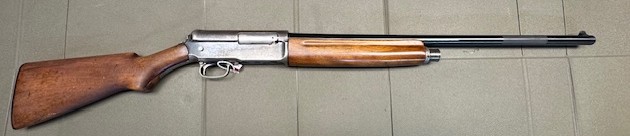
The great firearms genius, John Moses Browning (1855-1926), began designing firearms for the Winchester Firearms Company in 1886, and continued designing rifles and shotguns for Winchester until the turn of the century. He was not an employee of the company but sold his patent rights to Winchester throughout this period. Payment was made in the form of some cash, and the rest in Winchester products John and his brothers; Matthew, Thomas, William and George sold through their gun shop in Ogden, Utah.
John was a student of all sorts of firearms, and about this time he became interested in firearms that loaded and fired automatically. The Colt Firearms Company was already designing machine guns, so John's interest was in designing automatically loading firearms for the civilian market.
Working with some of the Winchester designers, he created and patented an auto-loading shotgun which he thought would be of great interest to civilian shooters. The president of Winchester was interested, but this time John did not want payment, he wanted a royalty on every one of his new designs that Winchester sold. Winchester had never done business in this fashion, they wanted the patents and nothing less.
Not to be deterred, John took his design to Belgium to have his shotguns made and also made a deal with Winchester's competitor, Remington Arms, to make and market his new shotgun. The new shotgun was quite popular, making Winchester realize the error they had made by refusing John's offer of royalty payments instead of buying his patents. Hoping to capture some of the market, Winchester set their chief designer to creating an auto-loading shotgun they could market.
The designer, Tommy Johnson, set about the task, but he could not utilize any of the patents that belonged to Browning. It took ten years to design the new shotgun, which Winchester introduced in 1911 as their Model 11. Their own advertisement was, "There are no moving parts outside of the receiver to catch on clothing, or projections or sharp points to injure the hands of the user of a Winchester self-loading shotgun."
The statement was true, because there was no bolt handle on the Winchester shotgun to open the breech. The patent on the bolt handle belonged to Browning and was readily available on the Belgian and Remington shotguns. To cock the new Winchester shotgun there was a knurled area near the muzzle that could be grasped and pulled rearward to open the breech and cock the firearm. This cocking system worked well if one had the arm strength to grasp the barrel and pull it rearward, but some shooters found it easier to rest the butt on the ground and use both hands to push the barrel downward.
If you picture this method in your mind, you will realize one's face is looking down into the muzzle of the shotgun. The Winchester Model 11 shotgun was soon dubbed, "The Widow Maker". Not a good selling point!
Winchester eventually sold 82,000 of these shotguns before they halted production in 1925. Ironically, the following year Winchester came out with their Model 12 shotgun which is one of the smoothest and most popular of all American made shotguns. They sold over 100,000 within the first two years of production and more than 2,000,000 before they halted production in 1980.
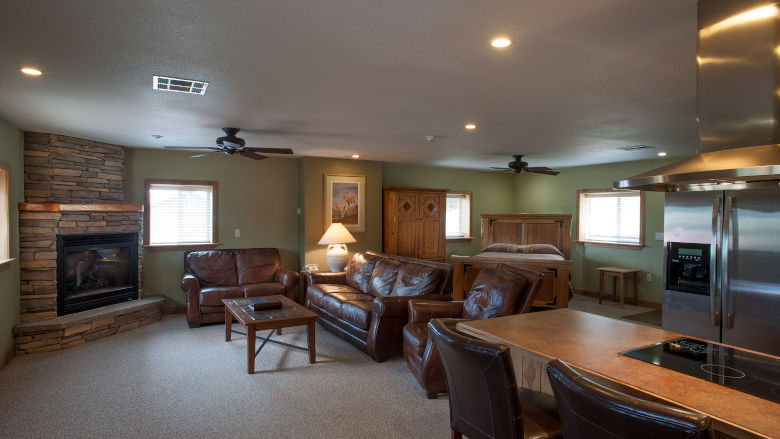
The general public is welcome to stay at the Whittington Center. There is a broad range of housing to accommodate individuals, couples, and small to large groups.
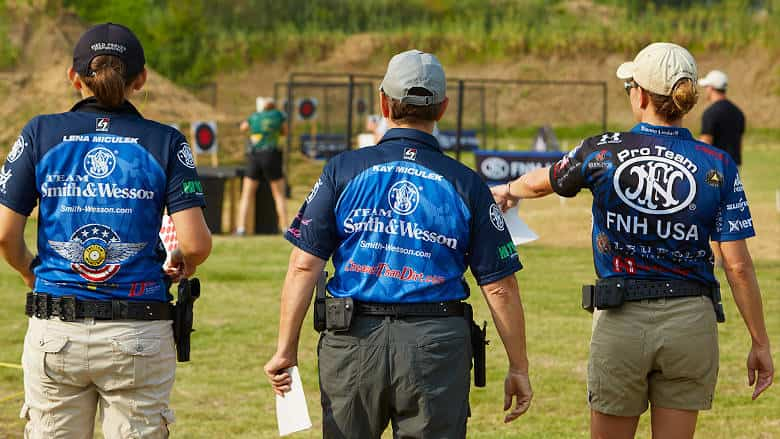
The NRA Whittington Center hosts hundreds of private and public events every year. Take a look at our schedule and plan your visit today.
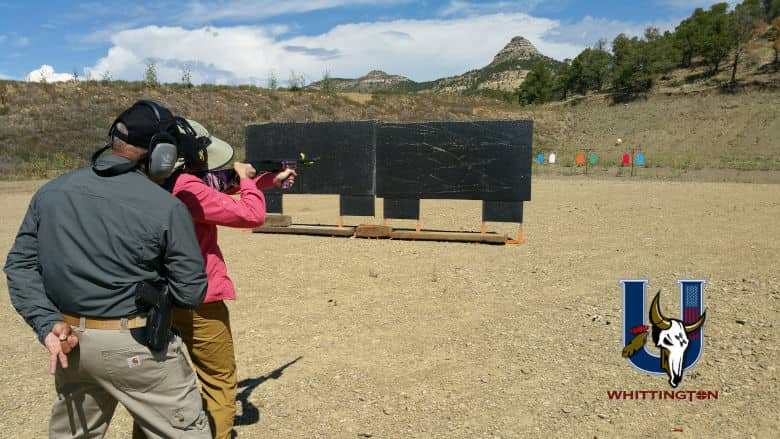
All Whittington-U courses are taught on 360 degree ranges where dynamic movement, defensive posture and the fundamentals of pistol marksmanship are emphasized.

Call 800-494-4853 or email [email protected]
© 2026 National Rifle Association of America. This may be reproduced. This may not be reproduced for commercial purposes. Privacy Policy